Insight · 24 November 2025
How and why are businesses getting started with hourly matching?
This blog post is the last part of our Hourly Matching in Practice series, which aims to help newcomers to this topic quickly get up to speed ahead of the changes to the GHG Protocol’s scope 2 emissions guidance. Throughout this series, we will help you understand the practicalities of hourly matching, and how your business can get started with it. Today, we explain how to get started as a business, and we share the different motivations of energy buyers across industries.
Hourly matching in practice series
This blog post is part of our Hourly Matching in Practice series, which aims to help newcomers to this topic quickly get up to speed ahead of the changes to the GHG Protocol's scope 2 emissions guidance.
- Part 1: What is hourly matching and what does it mean for your business?
- Part 2: What is a high matching score?
- Part 3: How can you do hourly matching with monthly certificates?
- Part 4: How and why are businesses getting started with hourly matching? (you are here)
How to get started with hourly matching as a business?
Hourly matching is becoming the practical next step for companies that want to understand and reduce their carbon emissions. The question we hear a lot is: “How do we actually get started?”
The answer is straightforward: by connecting what you already have.
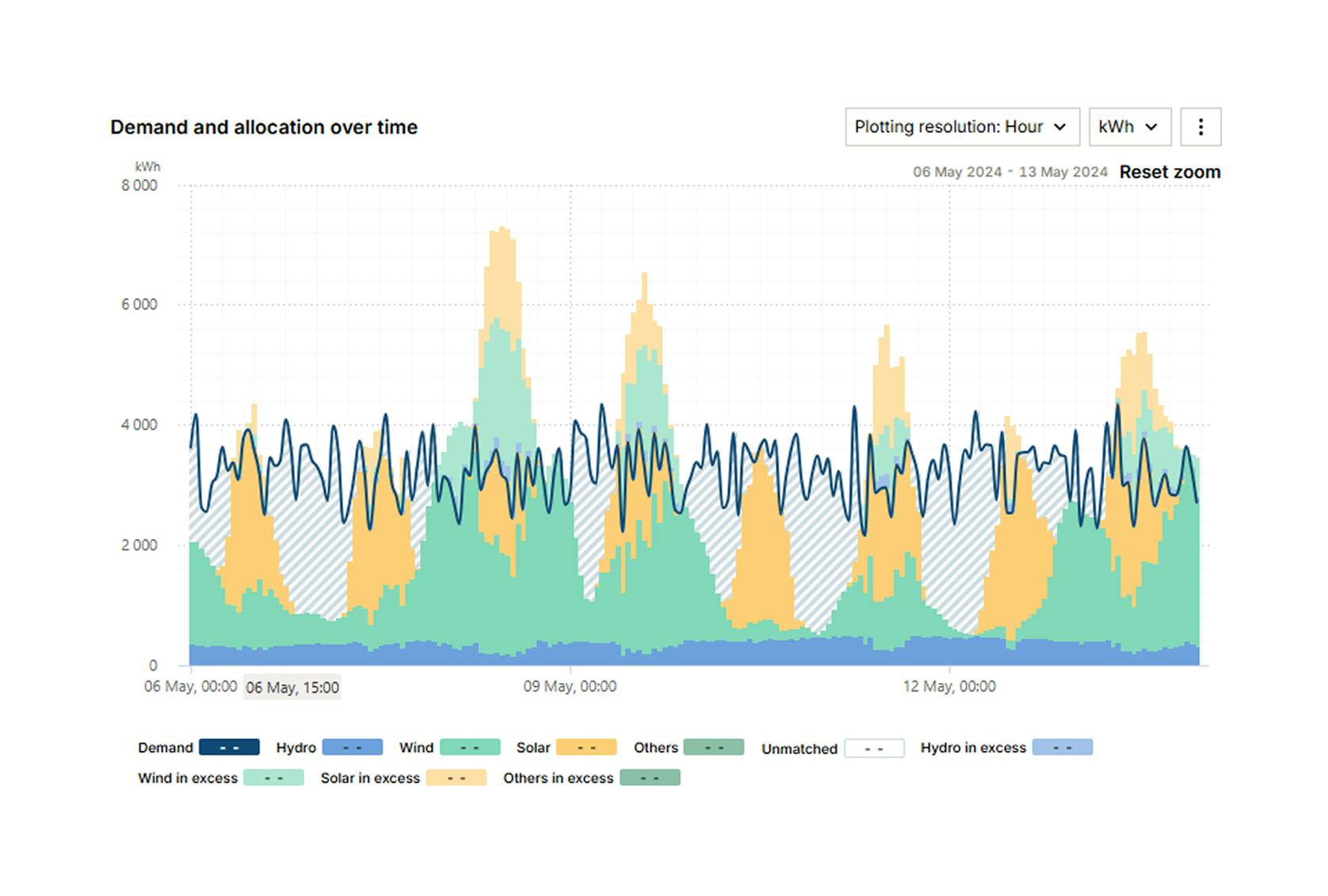
Electricity suppliers are able to connect various datasets to create an hourly picture: in this article, we explain how they connect generation metering data and renewable certificates and compare them to your consumption data to create an hourly view of renewable supply against demand. This results in an hourly matching score, which we explain here (What is a high matching score?)
In short, this first step, focused on gaining visibility, doesn’t require a new contract or a major system overhaul, just collaboration with your supplier. They tackle the technical setup, input existing data, and help you see how your electricity use aligns with the green energy you purchased hour by hour.
What drives businesses to move to hourly transparency?
We see more and more businesses move from annual or monthly renewable reporting towards hourly transparency. Their motivations differ; some seek data-driven proof of decarbonization, others aim to engage customers and employees, and others want to lead with credibility by complying with standards such as the Greenhouse Gas Protocol’s Scope 2. The GHG Protocol is the de facto global standard, used by over 90% of major listed companies to report their emissions. Proposed updates to the GHG Protocol’s Scope 2 guidance accelerate the shift towards hourly tracking of renewable electricity. Under the revised rules, carbon emissions will need to be reported on an hourly basis, bringing reported impact much closer to actual grid deliverability. For more information, read the summary of the proposed updates here, or find our latest webinar on the topic here.
We asked energy buyers across different industries to share their motivation:
Venue & live events - Silverstone, supplied by TEM. Alexander Webb, ESG Data at Silverstone:
“Renewable energy sourcing is central to our Shift to Zero campaign here at Silverstone, and will be crucial in reaching our emissions reduction goal of 50% by 2030. Transparency is a vital component for Silverstone to ensure our renewable energy is sourced from credible sources. Partnering with TEM (who uses the Granular Energy platform to deliver this) helps us achieve that transparency – by creating these reliable, tangible stories, we can engage both internal and external stakeholders, bringing them on the journey to Zero with us.”
Commercial real estate & facilities management - JLL, supplied by SmartestEnergy, Mr David Mead, Associate, Property & Asset Management, JLL:
“Driven by our own commitments, which are aligned to UKGBC (UK Green Building Council) guidance, we support the development of higher standards in renewable electricity contracts and reporting. It is essential that organisations enhance energy supply chain transparency and embrace accountability on their journey to reach net zero and the transition to a sustainable future.”
DataCenter - Digital Realty, supplied by PPC, Mr Dimitris Kantaros, Greece Operations Director:
“Through our collaboration with PPC and Granular Energy, we’re taking important steps toward more granular, hourly tracking of renewable energy consumption — a key enabler of the next phase of corporate decarbonization. ”
Concrete next steps to kick off
To get started, start a conversation with your electricity supplier:
- Ask them to share an 'hourly matching score' for the renewable electricity you buy
- On the back of your monthly certificate purchases and allocation, they will bring more granular data and provide an hourly matching score
We help suppliers across the globe provide this level of insight and transparency to their customers, which results in a clearer, more dynamic understanding of how renewable your energy really is throughout the day — and where you can improve next.
Want to see what an hourly report could look like?
Leave your contact details and we'll reach out to help you request your first hourly matching report from your supplier.
Even if they are not offering hourly data yet, we'll do our best to make it happen.
Share article
More insights
News · 07.10.2026
Granular Energy and STX Group collaborate to help corporates navigate the next generation of renewable energy procurement
The partnership gives corporates the tools and market access to measure hourly matching across their renewable portfolios and prepare for time- and location-based sourcing requirements.
14.09.2026
Carbon-Free Chronicles August 2026: the essential round-up of news and reports relating to hourly transparency
The big story of the month: Spain drafted the most ambitious hourly matching mandate yet for data centres, tying grid access itself to 80% hourly renewable coverage. Meanwhile in the Democratic Republic of Congo, Africa's first 24/7 solar-plus-storage baseload plant came online at a copper mine. Events are back up and running after a summer break so there are plenty of opportunities to find the team. Here is what has been on our radar.