· 16 June 2026
Renewables markets at a crossroads: our takeaways from the RECs Market Meeting
Granular Energy joined the 14th edition of the RECs Market Meeting last week in Prague as one of the meeting sponsors. Here are our main takeaways:
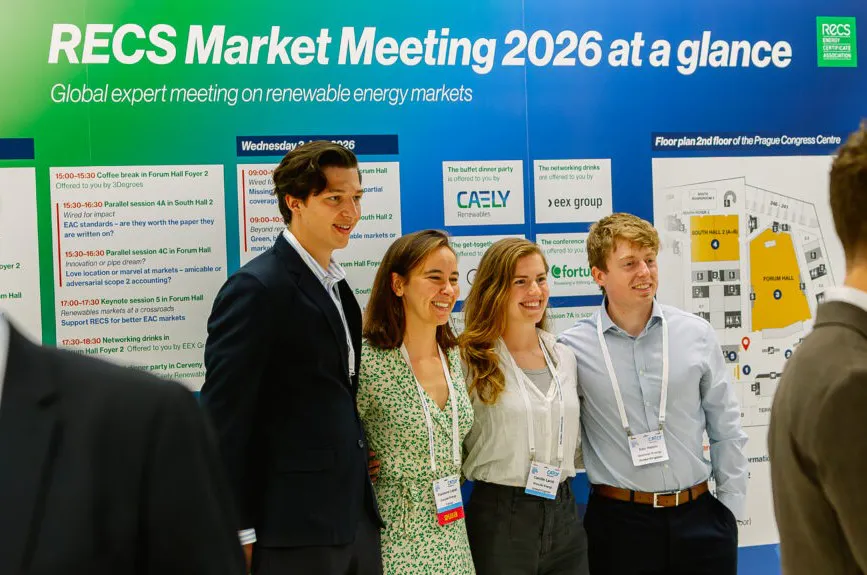
The conference's theme, "Renewables markets at a crossroads", captured the mood accurately: after two decades of growth, the GO market is maturing into a more complex environment. Structurally low prices and recent price increases, while mounting pressure from evolving regulatory standards is forcing the market to ask harder questions about its own credibility and long-term relevance.
Generally the atmosphere in Prague was notably positive, and for straightforward reasons. EAC prices in the EU are above €1.50 per MWh lately, driven partly by low Norwegian hydro levels compressing near-term supply, and sentiment-driven momentum has taken hold. Spot prices are trading at a premium to forward curves. After years of price levels that many participants found discouraging, the uptick has improved confidence.
Granular Energy was present with Eleonore, Camille, Eoin, and Pal in Prague. What follows is our reflections on the official positions argued from the podium, and the rather more candid views exchanged between sessions:
Eleonore: reading the room and pushing back
Eleonore, who spoke on one of the conference's panels, was alert to the fragility behind the price hike. Higher prices send a signal to generators that renewable certificates carry real value. But the market's long-term relevance cannot rest on a weather-driven supply squeeze.
The opening keynote set the stakes directly: are voluntary renewable energy markets sustainable, or will only compliance mechanisms deliver change at the pace the transition requires? Voluntary action has structural limits: buyers who find the market too complex or too expensive will simply exit. At the same time, mandatory rules must be pragmatic enough to avoid an unnecessary rise in complexity.
Eleonore used her panel appearance to make a call for market paticipants to be more ambitious and evolve the EAC market to be more entrenched and essential to the energy transition, at risk of staying still and becoming irrelevant. Voluntary markets are not an end state. They are a testing ground for innovations around EACs, where stakeholders can iron out some of the existing hurdles while creating financial value in the process.
Eoin: a missing argument
"Demand destruction" was a recurring worry in the sessions Eoin attended: would stricter matching rules push buyers out of the market? Yet the argument undercut itself. The same speakers warning stricter rules would drive demand away also insisted credibility and integrity are what keep demand in the market. However, credibility is what stricter, more transparent rules are built to deliver. The same is true of oversupply in the EAC markets, which the conference agreed is damaging: prices that fall too low erode the very credibility the market depends on, since a certificate that costs almost nothing ends up signalling almost nothing. However, potential cost increases was another recurring argument used against stricter matching rules.
A more interesting question went largely undiscussed: if demand does leave, which demand is it likely to be? If some of that demand thins out, a price floor for EACs could begin to re-establish itself. Stricter matching works the same way on the supply side by creating scarcity when renewable generation is low, exactly when the grid most needs to direct investment toward new assets like storage. Managed scarcity is not simply a threat to the market; it creates price signals highlighting periods where supply is needed. However, as rightly pointed out during the conference, the task is to balance this against the hurdle rate facing new entrants, who sit at different stages of their decarbonisation journeys. It must be high enough to mean something, but not so high it shuts out players early in their decarbonisation journey. After all, as everyone agreed in the end, the goal is impact.
Camille: a global market amid growing standards pressure
One of the more visible shifts at RMM 2026 was the growing presence of EAC market participants from Asia, Latin America, and Africa. The topics debated in Prague are relevant globally to industry players as well as buyers. Each certificate system operates under different registry rules, subsidy frameworks, and disclosure requirements. A buyer making renewable energy claims across multiple geographies faces a genuinely fragmented landscape, from how to procure effectively to how to account correctly amidst changing standards, which raise the bar for what qualifies as a valid claim.
As one session put it: the perfect should not be the enemy of the good. The market has built real infrastructure over twenty years. The risk of fragmentation isn’t just that it slows any one region down; it’s that divergence across markets erodes confidence in the system as a whole. For an instrument whose value is fundamentally tied to trust, that’s not a secondary concern.
The conversations in Prague revealed how much active debate remains, and showed there’s a clear appetite to resolve these questions together rather than diverge further.
Pal: the complexity problem is solvable, but the work has to start now
Beneath every debate in Prague: matching rules, standards, harmonisation, one constraint kept recurring: complexity. Participants cited it as one of the primary reasons for caution.
Complexity, however, is not a reason to hold back. Power markets are among the most intricate systems in the global economy: balancing mechanisms, settlement regimes, capacity markets, interconnection rules. Yet they function precisely because suppliers, traders, and technology providers have built the expertise and infrastructure to manage that complexity. EAC markets don’t have to be that different. Much of the operational burden stems from fragmented registry systems, diverging local regulations, and manual workflows that have not kept pace with the market's ambitions. That is a solvable problem: through better tooling, automation, and the market participants who are already building the systems to manage it..
This matters more now than before. The demand for clean, credibly documented energy is rising, driven by AI infrastructure, data centres, and the electrification of industry and transport.
Keeping complexity manageable is not a technical afterthought. It is the precondition for everything else the market wants to achieve. The work digitising registries, automating workflows, harmonising standards should start now, regardless of where the policy debates land.
Share article
More insights
14.09.2026
Carbon-Free Chronicles August 2026: the essential round-up of news and reports relating to hourly transparency
The big story of the month: Spain drafted the most ambitious hourly matching mandate yet for data centres, tying grid access itself to 80% hourly renewable coverage. Meanwhile in the Democratic Republic of Congo, Africa's first 24/7 solar-plus-storage baseload plant came online at a copper mine. Events are back up and running after a summer break so there are plenty of opportunities to find the team. Here is what has been on our radar.
Insight · 20.08.2026
REC Portfolio Management 101: what it is and why it gets complicated
Renewable Energy Certificates (RECs) are the instrument companies use to prove their electricity purchases come from renewable sources. As more companies report their usage of clean energy, REC portfolios grow alongside, creating challenges and liabilities. This article covers what RECs are, why REC management can get complicated, and how a purpose-built REC management tool can help portfolio managers.