Insight · 8 January 2026
Study highlights rapid growth of new category of energy tariffs offering more credible renewable energy procurement
In the past 12 months, the number of ‘hourly matching tariffs’ - which provide businesses with traceable clean energy – has seen a four-fold increase and are now available in many countries. Today we launch the State of Hourly Matching report, alongside the list of suppliers offering or about to offer such tariffs.
View the dedicated page and list of suppliers providing hourly matching tariffs here.
Clean energy procurement has become a central pillar of corporate decarbonisation, driving substantial investment in renewable electricity over the past decade. As these practices expand there is increasing scrutiny on the credibility of clean energy claims.
Most existing corporate clean energy accounting approaches rely on annual matching, which consists in proving a total volume of renewables was purchased over a year, but fails to reflect when and where electricity is actually generated and consumed. This limitation has led to growing interest in hourly matching, a method that aligns renewable electricity generation and consumption within each hour, offering a more accurate and transparent basis for clean energy and emissions claims.
The leading international accounting standard for carbon emissions, the Greenhouse Gas Protocol, has recently proposed a revision that would require hourly matching to calculate carbon emissions associated with electricity consumption. Furthermore, in 2023, the EU introduced an hourly matching requirement for green hydrogen in its Renewable Fuel from Non-Biological Origin (RFNBO) regulation, and has since incorporated similar requirements into the updated rules for the Carbon Border Adjustment Mechanism (CBAM), a system that applies a carbon cost to goods imported into the EU based on their embedded emissions. While the hourly matching requirement under the RFNBO regulation will only apply from 2030, the corresponding requirement under the CBAM regulation took effect on 1 January 2026.
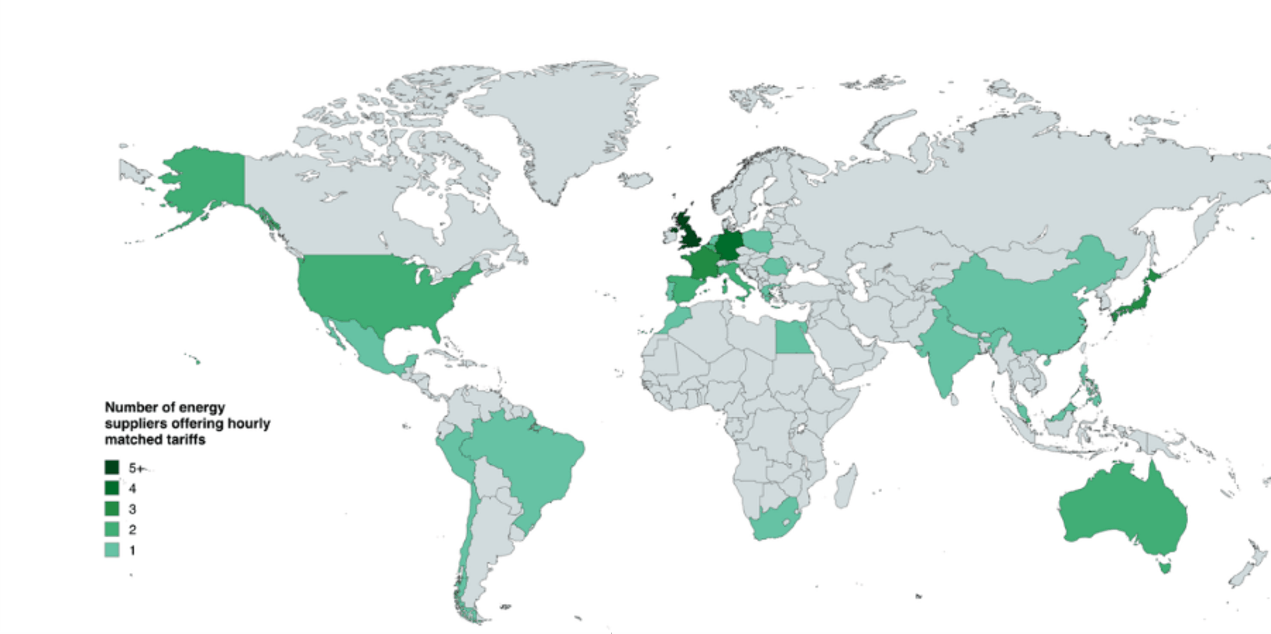
With these changes upcoming, Granular Energy and Baringa surveyed electricity suppliers around the world on the availability and development of hourly matching tariffs. The resulting report, published today, shows that hourly matching has grown from a pioneering concept to a more widely available energy supply product. Although adoption is uneven across regions and customer types, energy suppliers in many of the world’s largest electricity markets are now offering, or preparing to offer, hourly matching tariffs.
Of the 75 survey responses, a total of 52 energy suppliers reported that they already offer an hourly matching tariff to corporate customers or plan to introduce one within the next six months. Most of these offerings have been launched within the past two years, with a fourfold increase over the last year alone, indicating a rapid acceleration in adoption.
The survey results have major implications for the feasibility of implementing hourly matching for companies. With more hourly matching tariffs available, the burden of implementation shifts from energy buyers to energy suppliers, dramatically streamlining and simplifying the process for businesses to comply with the Greenhouse Gas Protocol’s new proposals.
The survey also highlights remaining challenges. As might be expected for a new product, the most frequently cited obstacle is the lack of customer demand. Cost and system complexity are also prominent concerns. Data availability is considered a barrier by a smaller share of suppliers, although it remains a practical issue in certain regions.
Map of countries with hourly matching tariffs
Bruno Menu, co-founder and COO of Granular Energy said: “We are delighted to publish this report with Baringa. The results show that hourly matching has moved from a pioneering concept to a mainstream product offered by many of the world’s largest energy companies.”
Ryan Thomson, Partner at Baringa said: “We are excited to launch this co-authored report with Granular Energy on the state of hourly-matched tariffs around the world. It is fantastic to see the progress that has been made by suppliers globally to offer customers more credible alternatives to renewable procurement and reporting.”
Sam Kimmins, Director of Energy at Climate Group, the global non-profit which established the 24/7 Carbon-Free Coalition, said: "With the majority of energy suppliers surveyed now offering or planning hourly-matched carbon-free tariffs, businesses can expect hourly matching to become easier and more accessible, while providing them with more accurate information on their energy use. This report signals that 24/7 carbon-free electricity is becoming a core part of the global energy system."
Want to learn more? On January 22nd at 3 pm CET, we are hosting a webinar (guests to be announced) to dive deeper into the insights. Register here.
About Granular Energy:
Granular Energy is the leading provider of energy and certificate management software for energy companies. As consumers demand greater transparency into the source of their clean energy, Granular Energy helps utilities, suppliers and traders develop and scale the next generation of carbon-free energy programs. Our end-to-end certificate management platform streamlines existing processes, reduces risk, and enables unprecedented transparency at the annual, monthly, daily or sub-hourly level. Our platform used by over 30 utilities across 10 countries and is behind the world's largest 24/7 clean energy programs.
About Baringa:
Baringa is a global advisory firm serving clients globally, creating lasting impact for clients and pioneering a positive, people-first way of working. In the energy sector, we serve over 400 clients around the world and specialise in energy advisory, working with the world's biggest brands, governments and policymakers to help them navigate the energy transition. We are globally recognised as a market leader, having been voted Leading Energy & Utilities Advisor by the Financial Times in their annual survey of Management Consultants for six years running. Our 800+ power market experts analyse and design markets and policy; determine strategy and investment decisions; identify new commercial opportunities and manage risk. Our energy market models span 60 markets and underpin our advisory capabilities and deep-rooted understanding of energy fundamentals.
Share article
More insights
News · 07.10.2026
Granular Energy and STX Group collaborate to help corporates navigate the next generation of renewable energy procurement
The partnership gives corporates the tools and market access to measure hourly matching across their renewable portfolios and prepare for time- and location-based sourcing requirements.
14.09.2026
Carbon-Free Chronicles August 2026: the essential round-up of news and reports relating to hourly transparency
The big story of the month: Spain drafted the most ambitious hourly matching mandate yet for data centres, tying grid access itself to 80% hourly renewable coverage. Meanwhile in the Democratic Republic of Congo, Africa's first 24/7 solar-plus-storage baseload plant came online at a copper mine. Events are back up and running after a summer break so there are plenty of opportunities to find the team. Here is what has been on our radar.