News · 9 November 2026
Carbon-Free Chronicles October 2026: the essential round-up of news and reports relating to hourly transparency
In October, the GHG Protocol shared an update on Scope 2: two market-based methods, with hourly matching in one of them and no date set for when it becomes required. Spain softened its data centre decree but kept the 80% hourly requirement, and a new EPRI paper looked at what tighter deliverability zones do to emissions and prices. We also published a white paper with STX and signed partnerships in Japan and Indonesia. Here's what's been on our radar.

What we’re reading
GHG Protocol sets out its Scope 2 direction: two market-based methods and a longer pathway to required hourly matching
- On October 16th, the GHG Protocol published an update on where the Scope 2 revisions stand following the consultation. The Independent Standards Board (the body responsible for reviewing, overseeing, and approving standards) proposes two market-based methods that could coexist for a yet-to-be-determined period. The methods are based on the responses of the first consultation from January 2026:
- Method 1 incorporates hourly matching, deliverability and incrementality
- Method 2 maintains the status-quo from the 2015 Scope 2 guidance, allowing for annually-matched and geographically diverse claims
- How these work together is yet to be confirmed, and the details of this proposal are being worked out by the Technical Working Group. Regardless, this proposal confirms the shift to more granular accounting, even if more gradual than initially expected.
- The public can expect a second consultation in Q2 2027 with the final combined GHG Protocol-ISO standard due in Q4 2028. While regulations take their time, many market players have already moved or are planning to offer hourly matched products to companies.
Spain’s data centre decree keeps the 80% hourly requirement, raises the threshold and adds a five-year ramp
- In the August issue, we covered the first draft of Spain’s data centre policy proposing to require new data centres above 1 MW capacity to cover at least 80% of their hourly electricity consumption with renewable generation commissioned within 18 months of the facility starting operation. On October 26th, the Government shared a revised text with the following changes:
- a 10 MW threshold in place of the 1 MW threshold
- 36 months for the maximum age of the linked renewable asset
- minimum PPA term of 6 years
- batteries recognised as a viable supply asset
- This policy is among the strongest data centre specific policies for renewable energy supply. This targeted approach will support new, diverse renewable developments. The government aims to make a final decision by November 29th.
- Some market doubts are emerging, as Spain approaches an election. There are questions on whether the current opposition parties would maintain this direction of travel or reverse it.
Deliverability modelling paper shows tighter matching zones cost more but reduce more emissions
- A new EPRI paper models the GHG Protocol’s proposed hourly matching and deliverability rules for the US, testing different deliverability zone sizes and technology assumptions.
- The modelling results for 2035 show EAC prices rising to a maximum of $20/MWh within the narrowest zones, and a 7x reduction in consequential emissions.
- It’s unsurprising that tighter boundaries increase prices. These higher prices can go towards new developments that reduce grid emissions, stabilise variable renewable power, and increase the share of clean energy in each hour.
What we’re writing
Turning granular data into better procurement decisions - white paper with STX
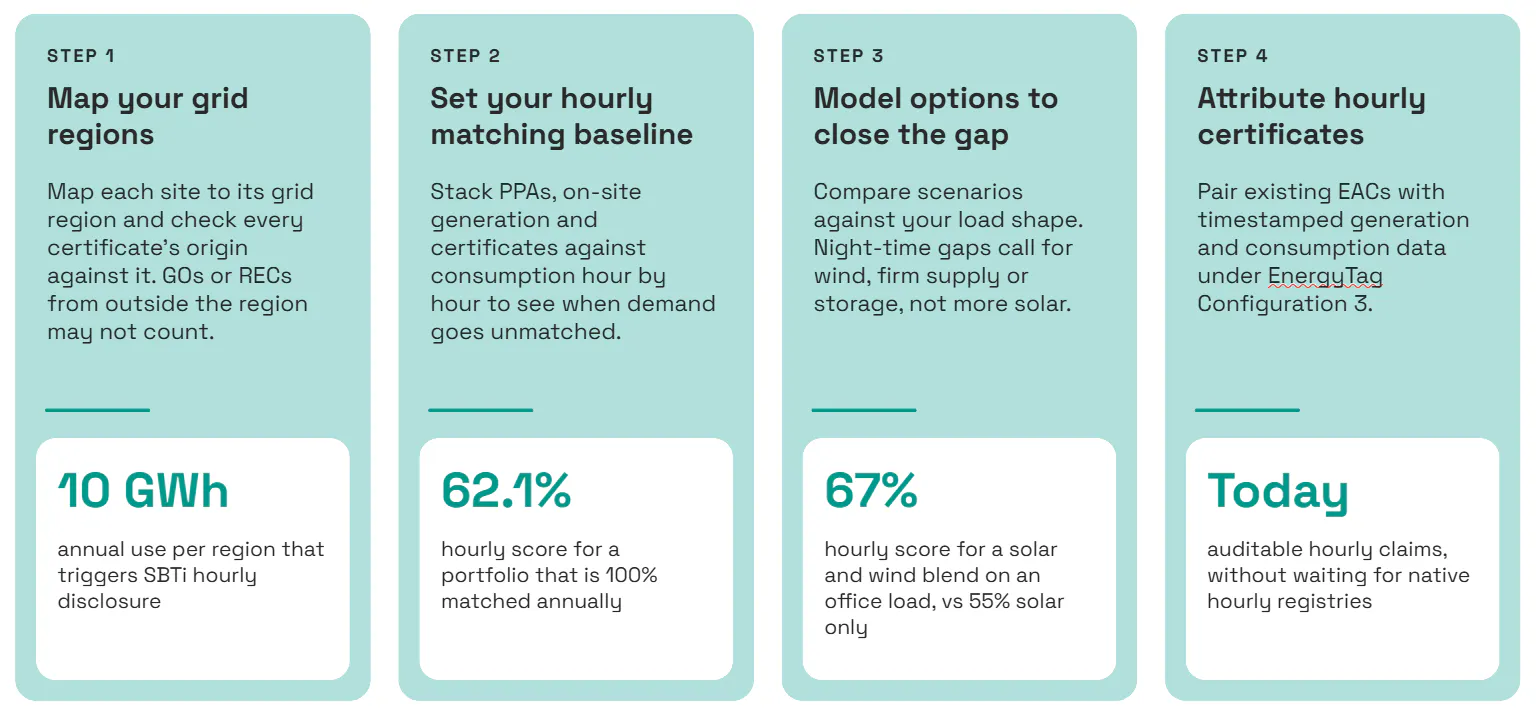
- With SBTi’s Corporate Net-Zero Standard V2.0 applying from February 2027, companies have started to explore how they will match consumption within deliverability regions and source hourly matched electricity.
- Our new white paper with STX walks through four steps to finding your perfect solution: (1) Set the geographical baseline by modelling your grid region (2) set your hourly baseline, (3) work on scenario analysis to see how you can close the gap and (4) make sure you can track it and have auditable claims. Through the Granular Energy platform, STX is working with companies to navigate each of these steps.
Insights from I-REC Day Japan
- Our colleague Nana Yamaguchi attended I-REC Day Japan 2026 and gathered her top takeaways in this article. Registries, policy experts, generators, buyers and financial institutions made clear how important EACs are becoming as Japan’s certificate market grows quickly.
- Japan’s certificate market is scaling fast, led by non-fossil certificates (NFCs). These NFCs lack hourly data, and that is becoming an increasing concern to corporates who want to align with SBTI V2.0 and potential revisions to the GHG Protocol.
Granular Energy and Mitsubishi Research Institute partner to bring hourly matching to Japan
- Mitsubishi Research Institute (MRI) is a Tokyo-based think tank and consultancy that advises Japanese energy sector companies on policy, energy, and technology. We are partnering to combine our hourly matching knowledge and expertise to their practice, and bring this market innovation to their clients.
- Our partnership with MRI is intended to help retailers, power companies, aggregators and corporates adopt EnergyTag-accredited systems. Together, we will help assess and explore market opportunities and interest for hourly matching, run pilots, and then see how we can deploy Granular Energy's solution at scale.
- Hourly matching is already a reality in Japan through our partnership with JERA Cross, and the rest of the market is looking at developing similar solutions.
PLN, PDG and Granular launch Indonesia’s first time-matching project
- PLN, Indonesia’s state-owned utility, Princeton Digital Group, a Singapore-headquartered data centre developer and operator with operations across Asia, and Granular Energy will spend 12 months testing time-based matching across PDG’s data centres in Indonesia, starting with 100% monthly matching.
- Through this pilot phase, PLN and PDG will together develop an ongoing T-REC (time matched renewable energy certificate) programme intended to start in 2028. This programme will provide a distinct path from monthly to hourly matching. Time-based matching can help further developments in Indonesia’s electricity supply, directing the right types of assets to the right locations and times of year.
Meet the team
- Bruno, Camille, El and Toby will be at RECS National GO Day in London on December 1st
Share article
More insights
News · 02.11.2026
Granular Energy and Mitsubishi Research Institute partner to bring hourly matching to Japan
Granular Energy and Mitsubishi Research Institute (MRI) have signed a memorandum of understanding to bring hourly matching to the Japanese market. The partnership, agreed on 8 October 2026, will help retailers, power companies and corporates adopt systems accredited by EnergyTag, the international non-profit that sets standards for tracking renewable energy hour by hour.